
International placement - Antimicrobial resistance
Dr Saied Ali is an ICAT fellow based at RCSI, supervised by Professor Deirdre Fitzgerald-Hughes (RCSI), Dr Liam Burke (University of Galway) and Professor Fidelma Fitzpatrick (RCSI). Saied is investigating the epidemiology and genomic characteristics of Carbapenamase-producing Enterobacterales (CPE) isolated from hospital environments in Ireland and Trinidad, and assessing the efficacy of disinfection processes.
Saied completed an international placement in Trinidad and Tobago through a research collaboration with the University of the West Indies (UWI). The placement was supervised by Dr Aarti Pustam and Professor Adesh Ramsubhag, and was designed to support a broader research programme examining the epidemiology and transmission dynamics of antimicrobial resistance (AMR), with a particular focus on CPE.
The primary objective of the placement was to establish a collaborative framework for the collection and characterisation of CPE isolates from hospital environments in Trinidad and Tobago, enabling genomic comparison with isolates obtained from healthcare settings in Ireland. Through whole-genome sequencing and plasmid analysis, the study aims to examine the distribution of resistance determinants and the plasmid backbones responsible for the dissemination of carbapenemase genes across geographically distinct healthcare systems. In addition to isolate collection, the placement sought to develop a systems-level understanding of the drivers of AMR within the Trinidadian healthcare context. This included qualitative engagement with clinical microbiology, infection prevention and control, and antimicrobial stewardship stakeholders to explore structural, infrastructural, and operational factors influencing AMR emergence and containment. Together, these activities aimed to generate comparative genomic and contextual data that could inform international collaboration on AMR surveillance, plasmid epidemiology, and infection prevention strategies across healthcare systems.
During his placement, Saied developed several research and professional skills related to conducting AMR research in resource-constrained healthcare environments, and established a collaborative framework between RCSI and UWI to support ongoing research on AMR. Several collaborative research outputs are currently in development. In addition to work examining AMR containment capacity within the Trinidadian health system, we are jointly preparing a review of AMR patterns across ESKAPE pathogens in Trinidad and Tobago, aimed at synthesising available microbiological surveillance data and identifying priority gaps for AMR monitoring in the region. We are also developing an epidemiological study examining environmental carbapenem-resistant Enterobacterales (CRE) detected in paediatric wards, exploring potential environmental reservoirs and their implications for infection prevention and control.
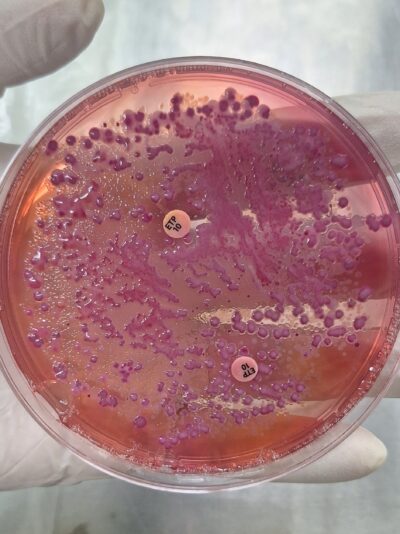
Pictured below: Saied Ali and Aarti Pustam at the University of the West Indies; cultured Klebsiella bacteria